CPU Design Splits Between Efficiency and Brute Force
Article

CPU Design Splits Between Efficiency and Brute Force

Three recent processor stories show the same divergence: chips are either engineered to sip power or deployed at datacenter scale to absorb demand.

BhavyaNovember 9, 20264 min read

Photo: Tom's Hardware

The recent processor news points to a single dividing line in CPU design. Some silicon is now engineered around efficiency so aggressive that thermal headroom stops being the design constraint, while other workloads are still solved by throwing enormous core counts and memory at the problem. Both approaches are advancing at once, and for US buyers and US chipmakers the practical question is which one a given job actually needs.

Efficiency as a Design Goal

DEEPX's demonstration of its DX-M1 processor is the clearest signal in the logged material. According to Tom's Hardware, the company ran a thermal benchmark in which a butter heatsink did not melt, presented as evidence of how cool the chip runs. The stunt is easy to dismiss as theater, but the underlying claim is not trivial. A processor that generates so little heat that a dairy-based heatsink survives is a processor whose thermal envelope has been pushed far below what conventional designs assume.

That matters because thermal headroom is usually the ceiling on everything else. Cooling, packaging, enclosure size and power delivery all scale with how much heat a chip dumps. When a vendor designs to a low thermal budget from the start, those constraints loosen across the whole system. It is a different engineering priority from raw throughput, and it is the kind of claim that invites scrutiny precisely because it is measurable.

Brute Force Still Wins Some Jobs

The World of Warcraft: Forever launch is the counterexample, and it is a large one. As Tom's Hardware reported, the launch used 70,480 CPU cores and 251 terabytes of RAM to keep millions of players online without a hitch. No efficiency trick makes that workload disappear. A game launch with that many concurrent users is a spike problem, and spikes are absorbed by capacity.

The numbers describe a server fleet, not a single processor, and that distinction matters for anyone reading them as a CPU story. Seventy thousand cores is an argument about aggregate compute and memory bandwidth, and 251 terabytes of RAM is an argument about holding state in memory rather than on disk. The lesson is that some workloads have no elegant low-power answer. They have a provisioning answer.

Two Budgets, Not One Market

Placed side by side, the DEEPX demonstration and the WoW launch describe two different budgets. One is a thermal and power budget, measured in watts and degrees. The other is a capital budget, measured in cores and terabytes. A chip designer optimizing the first is solving a different problem from an operator sizing the second, and conflating them produces bad purchasing decisions.

For US technology companies, that split has a direct consequence. Efficiency-led designs are attractive where deployment scale is constrained by power, cooling or physical space, and where the chip is one component in a product shipping in volume. Capacity-led deployments are attractive where demand is spiky and the cost of a failed launch exceeds the cost of idle hardware. Neither approach is universally superior, and the stories do not claim otherwise.


The Consumer Signal in a Pre-Built

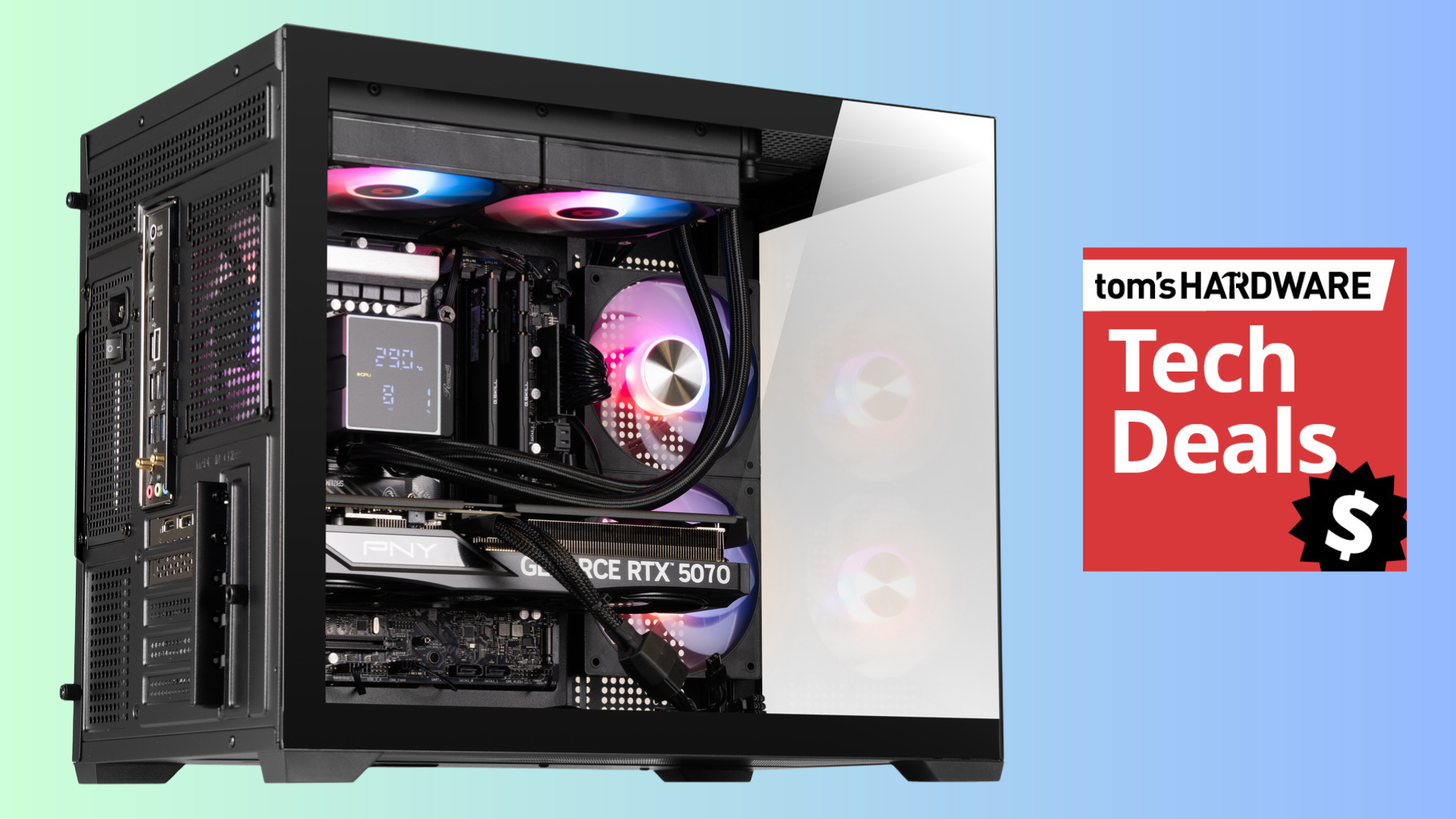
The ABS Flux II Aqua deal logged by Tom's Hardware sits closer to the consumer end of the same spectrum. The pre-built is priced at $1,999.99, a $300 saving, and pairs an Nvidia GeForce RTX 5070 with a 20-core Intel CPU, 32GB of DDR5 RAM and a 1TB SSD, pitched at 1440p and 4K gameplay.

Read as a processor story, the interesting detail is the 20-core count in a machine at that price. Core counts that once signaled a premium workstation tier are now part of a discounted gaming pre-built. That is the brute-force impulse reaching the desktop, though in a much smaller frame than a datacenter fleet. The 32GB of DDR5 is the same story told in memory: capacity that was recently a high-end specification is now a deal highlight.

For US consumers, the practical effect is that the capacity-led approach is affordable at the midrange. A buyer does not need to reason about thermal envelopes to benefit from core counts rising at a fixed price point. The trade-off shows up elsewhere, in power draw and cooling requirements that a pre-built vendor has already resolved on the buyer's behalf.

Why the Split Matters for US Vendors

The divergence has competitive weight. A US chipmaker competing on efficiency is competing on design and process, where the argument is made in benchmarks and thermal measurements. A US chipmaker competing on aggregate capacity is competing on supply, pricing and the ability to ship volume. The three stories do not establish which strategy is winning, and they should not be read as doing so.

What they do establish is that both arguments are being made publicly and in measurable terms. The DEEPX demonstration is falsifiable in the way a thermal claim is falsifiable. The WoW figures are specific enough to be checked against the operator's own disclosures. And the pre-built price is a number a consumer can verify at checkout. That is a healthier basis for a purchasing decision than a general claim that chips are getting faster.

What to Watch

The next signal to watch is whether efficiency claims of the DEEPX kind migrate from demonstrations into shipping products with published thermal specifications, since a butter heatsink is evidence of intent rather than of a product line. On the capacity side, the WoW launch figures set a reference point for how much aggregate compute a large online launch now assumes, and later launches will be measured against those numbers. For the desktop, the ABS Flux II Aqua deal is a marker for what a 20-core machine with 32GB of DDR5 costs after a $300 discount, and whether that configuration holds at that price is the question US buyers will actually be answering.

More on this beat: Hardware on TechManNews.

#CPUs#Processor Design#Thermal Efficiency#Datacenter Compute#Consumer PCs#US Technology Market

Newsletter

Get Tech News in Your Inbox

The latest AI, gadgets, software and startup stories from TechManNews, delivered every morning - free.