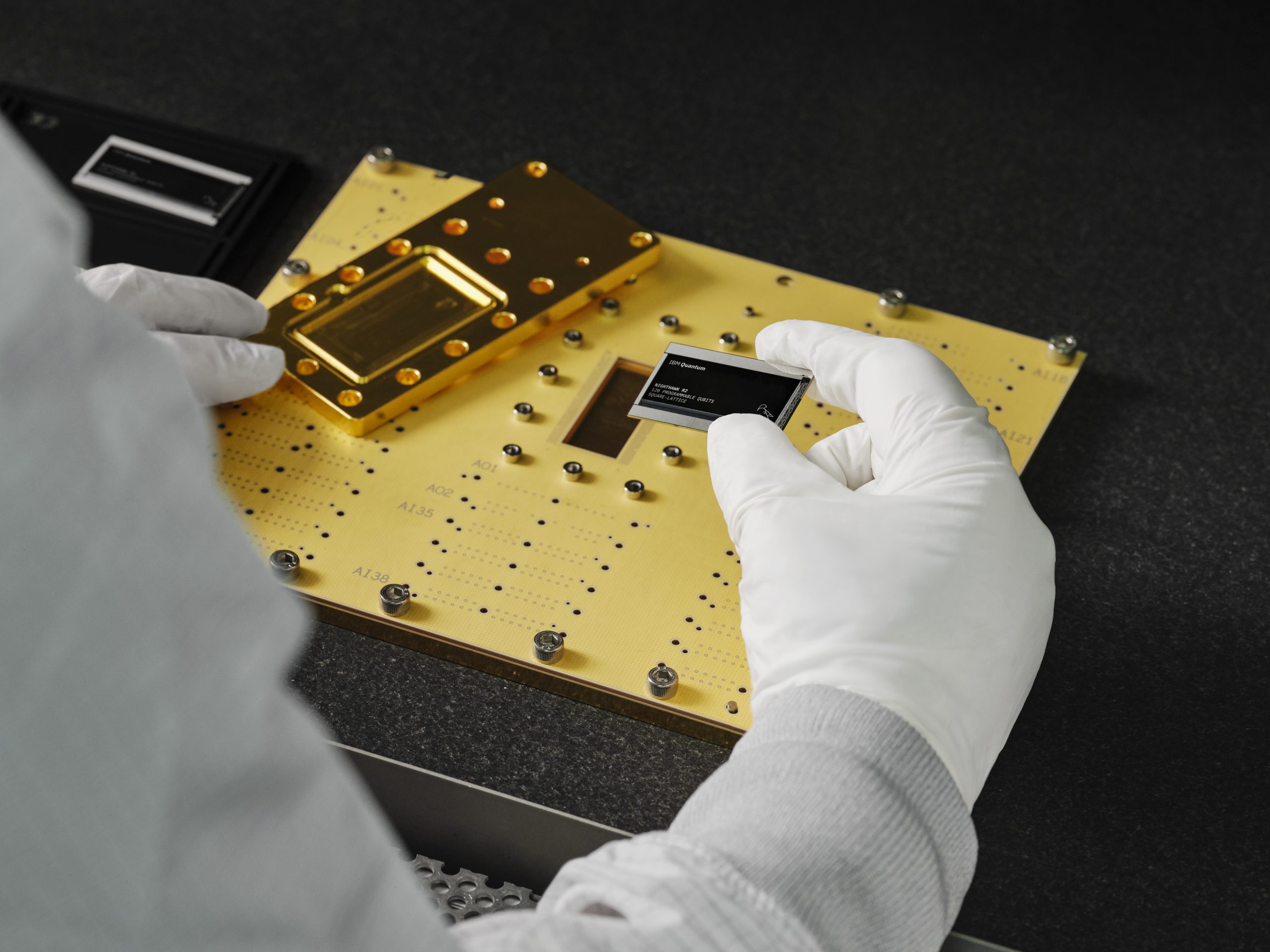
IBM Corp. introduced the Quantum Nighthawk r3 on Wednesday, a next-generation processor the company says is built to handle larger and more complex computations at high speed without sacrificing quality. The announcement affects researchers and developers who run workloads on IBM's quantum systems, and it sets up a 2027 plan to join two r3 processors into a single machine.
That combined system is intended to run up to 10,000 quantum operations and scale to more than 1,000 qubits across the two chips. The r3 itself is designed to support 10,000 operations on 520 programmable qubits with 2,034 physical quantum components, according to IBM. The company said the chip extends the high-speed architecture first introduced in the Nighthawk r2, which launched in September and supports more than 7,500 operations on 120 qubits.
Qubits are the basic unit of information in a quantum computer, analogous to a classical bit but able to hold a superposition of states, which allows parallel calculations. The r2 brought a high-speed reset design that shortens the idle period after a measurement, cutting the wait from roughly 200 milliseconds to about 25 nanoseconds without disturbing neighboring qubits. IBM said the r3 carries that same approach into larger systems. In Nighthawk, the qubits are superconducting and laid out in a square lattice; the programmable qubits are the active data units, while couplers and reset elements support them.
Jay Gambetta, director of IBM Research, said useful quantum computing depends on delivering results with both accuracy and speed, and that Nighthawk is already demonstrating that. He added that scaling the architecture to larger and more powerful machines will push quantum computation to new levels as IBM integrates more closely with classical resources and works toward fault tolerance.
IBM said it has already shown two technologies needed to combine r3 chips. This year it linked two Nighthawk r1 processors with four l-couplers, or long-range quantum interconnects that bridge separate processors into a larger machine, reaching 99.4% transfer fidelity against a target of 99.9%. IBM also connected cryogenic modules into a single system. In 2027, it plans to use those modularity advances to link two r3 processors into a 1,040-qubit system.
Separately, IBM said its IBM Quantum Platform cloud service now combines classical and quantum computing in one managed environment, letting users tie quantum workflows to high-performance computing resources, a laptop or supercomputers. Cleveland Clinic used the platform to process 2.6 million samples up to three times faster for modeling biological structures, according to IBM. The platform is also adding pulse-level access for error-correction research.
More hardware news from TechManNews.