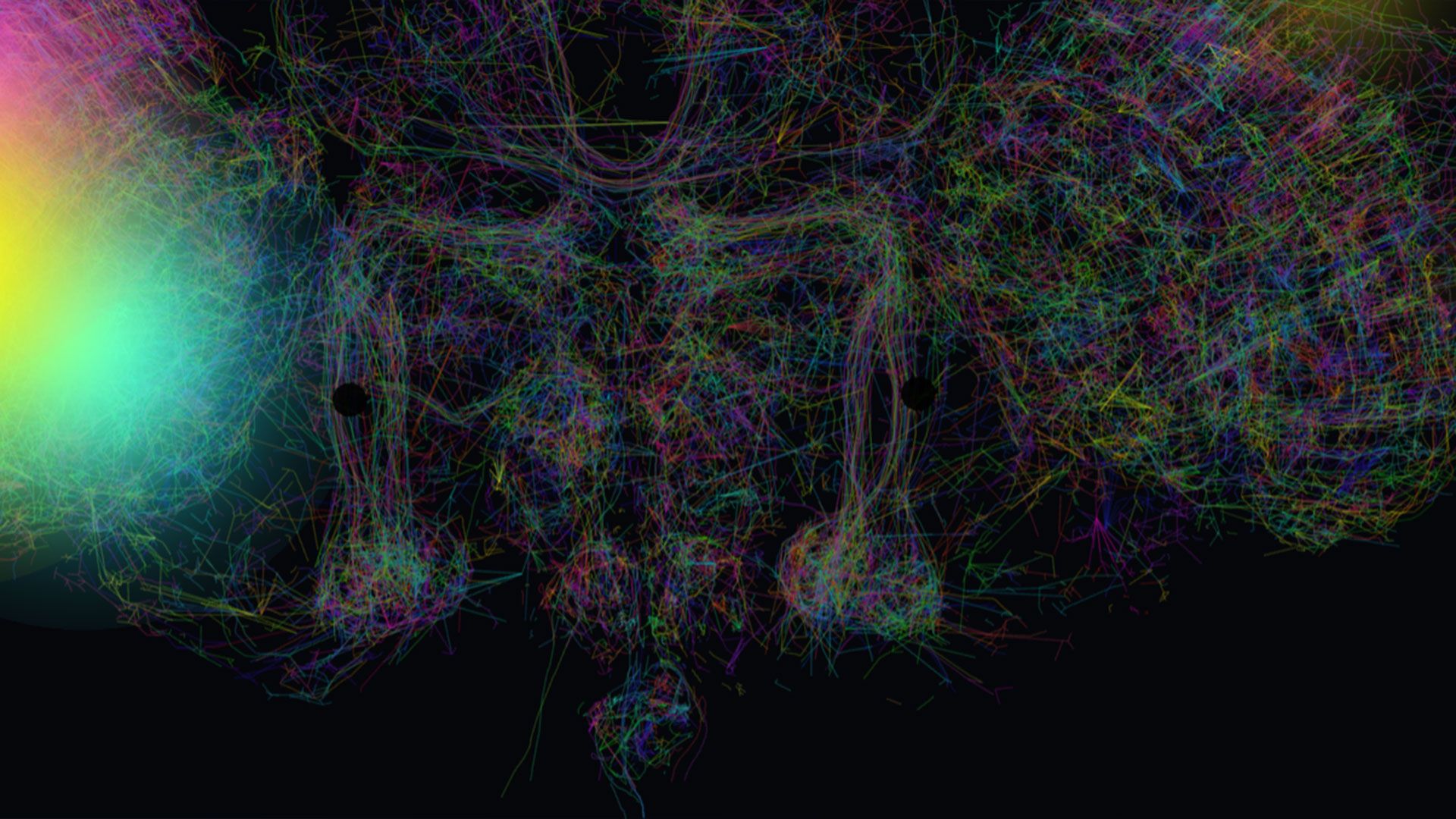
Bitcoin mining hardware maker FutureBit has built a browser-based proof of concept that mines Bitcoin using a simulated fruit fly brain. The project, called HashFly, is based on the fly brain and lets visitors run the miner in a web browser. FutureBit said the experiment offers insight into the potential efficiency of organic computing, also known as wetware.
The demo focuses on simulated photoreceptors of the type that would normally detect light in a fly's eye. According to the company, those receptors read a block header, and neurons called PPL101 cells activate when a double-SHA-256 target is computed. Users can raise or lower the difficulty by adjusting the number of zeros in the target. At the proof of concept's maximum level of 6, the work remains far easier than finding a real Bitcoin hash.
A reporter who tested the site found the web app showed "2,914 traces firing" inside the fly brain, a figure the article notes is a small subset of the 165,122 reconstructed neurons in the MaleCNS v1.0 fruit fly connectome. Running the miner for an hour at maximum difficulty checked off roughly 80 blocks. The same test produced a hash rate of about 100 kH/s, which the article contrasts with FutureBit's 5-inch cube Apollo III and its claimed 18 TH/s of hashpower.
FutureBit's projections go well beyond the browser demo. The company said that if the approach could be scaled on real organic neurons, it would hash at roughly 1 watt per terahash, which it described as about 10 times the efficiency of the best silicon 3nm ASICs. In a follow-up tweet, the company said those estimates are based on the total power used by the fruit fly, assuming all neurons could be devoted to Bitcoin hashing functions and kept firing continuously.
FutureBit said it is working on simulating all neurons in the dataset with the SHA-256 hash function and will publish its findings. That work has not yet been released. The demo arrives after Google announced it had published the complete brain and central nervous system of an adult male fruit fly.
The fly connectome release has prompted a cluster of other experiments online, including attempts to see whether the mapped brain could play Doom or take part in financial day trading. A rival cryptomining scheme called FlyMiner also appeared, pairing a fruit fly connectome with an ASIC miner. FlyMiner states it has almost zero chance of mining success, making it, like HashFly, more a brain-related demonstration than a route to crypto payouts.
More hardware news from TechManNews.