The CPU Beat Is Being Written Outside the Boardroom
Article

The CPU Beat Is Being Written Outside the Boardroom

Intel's market-share recovery, a 357-chip die-shot archive and an AI-assisted BIOS hack all show that the CPU story in 2026 is shaped as much by outsiders as by the vendors.

ManishankarNovember 21, 20264 min read

Photo: Tom's Hardware

The three stories logged on this beat share one thread: the terms of the CPU business are increasingly set outside the vendors' own roadmaps. Intel's return to overall market-share leadership, AMD's continued server gains, an enthusiast's archive of 357 processor die shots and an AI-assisted attempt to revive non-K overclocking all point to a market where outside observers and outside tinkerers shape what the silicon means. For US technology companies and US buyers, that cuts both ways.

The Vendor Ledger

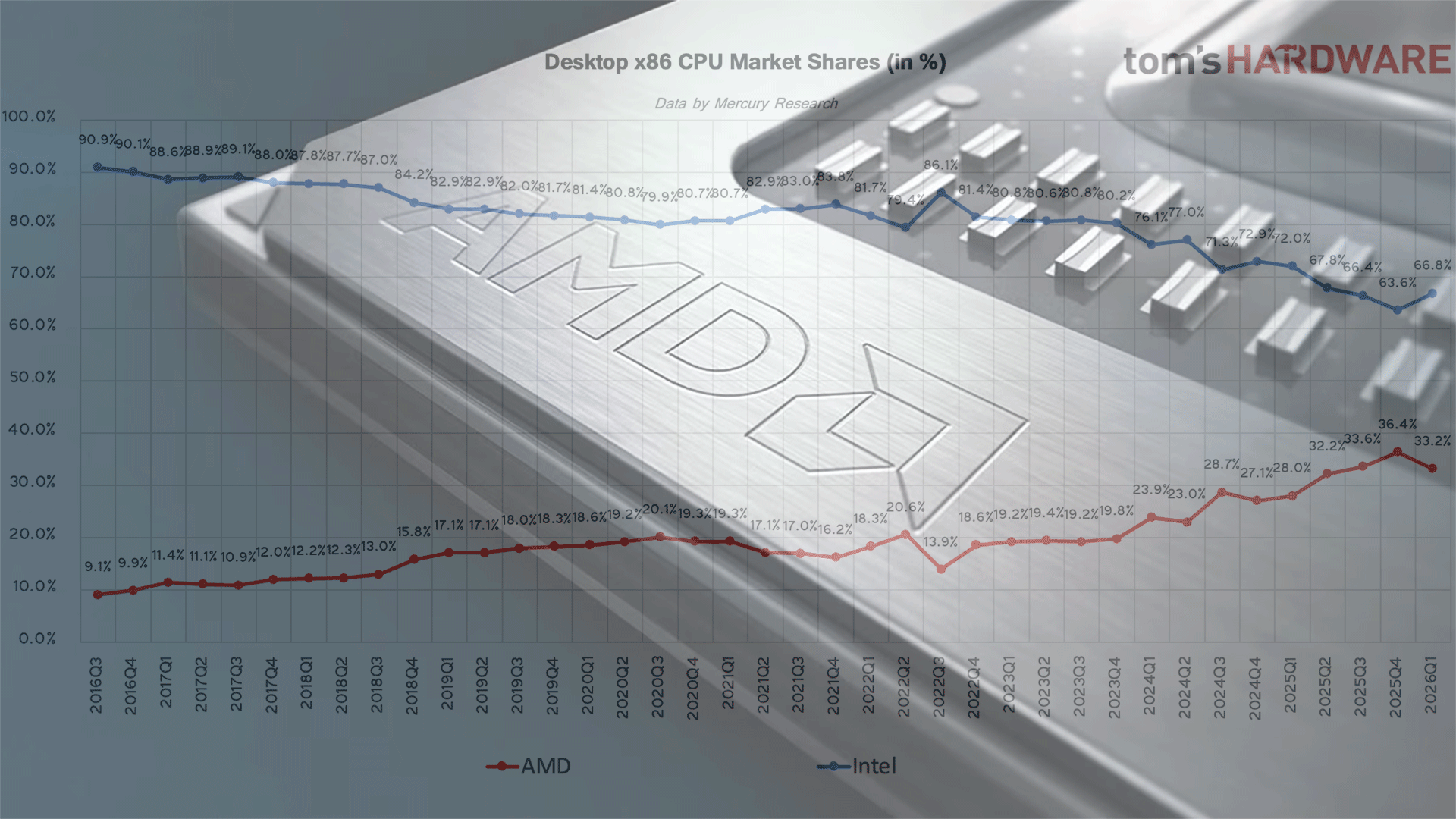
The headline market fact comes from Mercury Research, via Tom's Hardware: Intel has reclaimed overall CPU market share for the first time since 2025. The same research shows AMD continuing to gain server CPU market share, driven by skyrocketing shipments of data center processors, while sales of client CPUs drop in the third quarter. That is a split verdict, not a comeback narrative. Intel's overall position improved even as the mix shifted underneath it: client volumes fell, and the fastest-growing part of the market, server, kept moving toward AMD.

For US companies buying processors, the practical meaning is that vendor negotiations rest on a different footing than they did a year ago. Intel can point to the aggregate share number; AMD can point to data center momentum. Neither side can claim the whole board. Intel's overall lead was recovered in a quarter when client sales dropped, which suggests the headline share figure should be read alongside the segment numbers rather than instead of them.

A Market Measured From Outside

What makes the Mercury data notable on this beat is who produces it. Market share on x86 is not reported by Intel or AMD in comparable form; it is assembled by an outside research firm and then reported onward. That arrangement is normal, but it means the vendor scoreboard is an external artifact, subject to methodology and revision. Tom's Hardware's reporting of the Mercury figures is itself part of the chain that turns shipment data into a public claim about who is winning.

The die-shot archive reinforces the same point from a different angle. An enthusiast assembled a visual database of 357 detailed CPU die shots spanning 1971 to 2024, as Tom's Hardware reported. That is a substantial piece of technical documentation produced without vendor participation, covering legendary and lesser-known processors alike. For US engineers and students, it is a free reference on how processor designs evolved across five decades. For the industry, it is a reminder that much of the historical record of this beat is maintained by outsiders.


Help From Anyone

The third story pushes the pattern further. After ASRock discontinued SkyOC following Intel's efforts to block non-K CPU overclocking, an enthusiast turned to AI to see whether the old workaround could be adapted for newer platforms, according to Tom's Hardware. The enthusiast is described as using a vibecoded BIOS modification. Two things stand out. First, the workaround targets Intel's restrictions on overclocking its non-K parts, a product segmentation decision made by the vendor. Second, the tooling used to revisit it is generative AI applied to low-level firmware.

For US consumers, particularly hobbyists and small builders, the appeal is obvious: non-K chips are cheaper than unlocked parts, and any workaround extends what those chips can do. For US vendors, the story is a control problem. Segmentation is enforced through firmware and silicon features; when enthusiasts can generate and test BIOS modifications with AI assistance, enforcement becomes an ongoing effort rather than a one-time design choice. The fact that this is being attempted now, years after ASRock dropped SkyOC, shows that abandoned workarounds do not stay abandoned when new tools make them cheaper to retry.

The American Frame

Taken together, the three stories describe a market where the vendor's own narrative is only one input. Intel's overall share recovery and AMD's server gains are real, but they arrive through an external measurement apparatus. The industry's design history is being preserved by an enthusiast. Product segmentation is being probed by a hobbyist with AI tools. For US technology companies, this means competitive position is increasingly argued in public, with outside data and outside experiments as the evidence. For US consumers, it means more information and more tinkering options, but also more claims to sort through.

The American dimension is not abstract. The vendors in question are US chip designers competing for US data center and client spending, and the research firm's data is the reference point US buyers and investors use to judge them. The die-shot archive is an American publication's reporting on a community project. The BIOS experiment is the kind of enthusiast activity that US hobbyist culture has long sustained. The beat's center of gravity remains the vendor, but its information supply is distributed.

What to Watch

The next Mercury Research quarter will show whether Intel's overall share recovery holds if client CPU sales keep dropping and server shipments keep rising toward AMD. The die-shot gallery's coverage through 2024 invites extension to newer parts, which would test whether community documentation keeps pace with the designs it records. And the AI-assisted BIOS work is worth following for whether it produces anything usable on newer platforms or remains an experiment, and whether Intel responds with further blocking efforts as it did against SkyOC. None of these outcomes is settled. The pattern is that they will be reported, documented and probed largely from outside the companies that make the chips.

More on this beat: Hardware on TechManNews.

#CPUs#Intel#AMD#market share#overclocking#silicon history

Newsletter

Get Tech News in Your Inbox

The latest AI, gadgets, software and startup stories from TechManNews, delivered every morning - free.