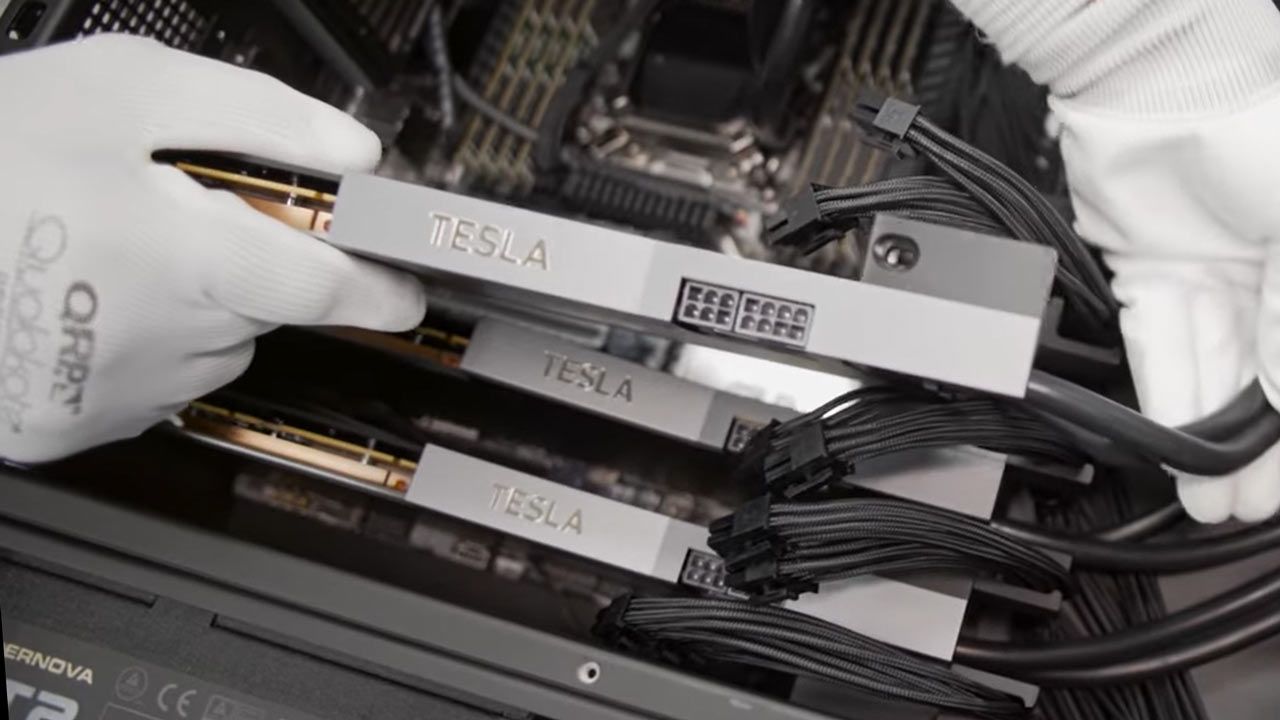
Nvidia CEO Jensen Huang said the company is considering charging about $2,000 per GPU per year for the software needed to run AI agents on its infrastructure. Huang disclosed the figure at GTC Berlin on October 22, where Nvidia presented a wider effort to grow a business spanning chips, software and AI-agent security. He said software licensing is set to become a larger share of Nvidia's revenue and described the roughly $2,000 annual per-GPU charge as an example of how the company would license the software it supplies for running agents on AI factories. For US enterprises building out AI infrastructure, the proposal signals that the cost of Nvidia hardware may increasingly come with a recurring software charge attached.
The arithmetic scales steeply. At $2,000 per GPU each year, five million GPUs under paid licenses would generate $10 billion in annual revenue, or $50 billion over five years if customers keep renewing. Nvidia has not said how many GPUs the proposed fee would cover, whether $2,000 is its standard price, which software the license would include, or whether products would overlap.
Those gaps matter because Nvidia already sells enterprise software. Its AI Enterprise platform is listed at $4,500 per GPU for a one-year subscription. The $2,000 figure Huang cited is lower, but Nvidia has not confirmed that the two prices cover the same products or licensing terms, so the number should not be read as a confirmed price cut.
The licensing discussion comes as Nvidia builds out the infrastructure needed to deploy and manage AI agents in enterprises. Such systems can use tools, reach data and carry out tasks, which creates security and management problems for companies running them at scale. On October 21, Nvidia announced its OpenShell Reference Architecture, which combines Vera Rubin computing infrastructure, Vera CPUs and BlueField-4 data processing units running Nvidia Sentry. OpenShell provides a secure runtime for AI agents with boundaries around their actions and access to tools and resources, while Sentry monitors agent activity independently and can quarantine an agent that tries to cross those boundaries, according to Nvidia. The design puts security controls into the underlying infrastructure rather than relying only on safeguards inside an AI model or application.
Nvidia introduced its Open Agent Safety Platform in September, and the newer reference architecture extends that approach to enterprise infrastructure and edge systems. Other companies are adding the controls to their products: Anthropic is integrating OpenShell and BlueField hardware with Claude Managed Agents, and Salesforce has built a Slack Admin Bridge for OpenShell that lets administrators review agent access requests, approve or reject permissions and monitor activity in Slack.
The pricing proposal fits Huang's argument that Nvidia is more than a GPU supplier, having expanded into networking, systems, enterprise software and AI infrastructure. On the BG2Pod podcast, he said people might one day stop categorizing Nvidia as a chip company, citing its presence in healthcare, automotive, telecommunications and life sciences. Nvidia has not said when the $2,000 per-GPU fee would take effect, which software it would cover, or how it would fit its existing enterprise software business.
More AI news from TechManNews.